Healing From Family Scapegoating Abuse (FSA) Begins With Understanding What Happened To You In Your Family…
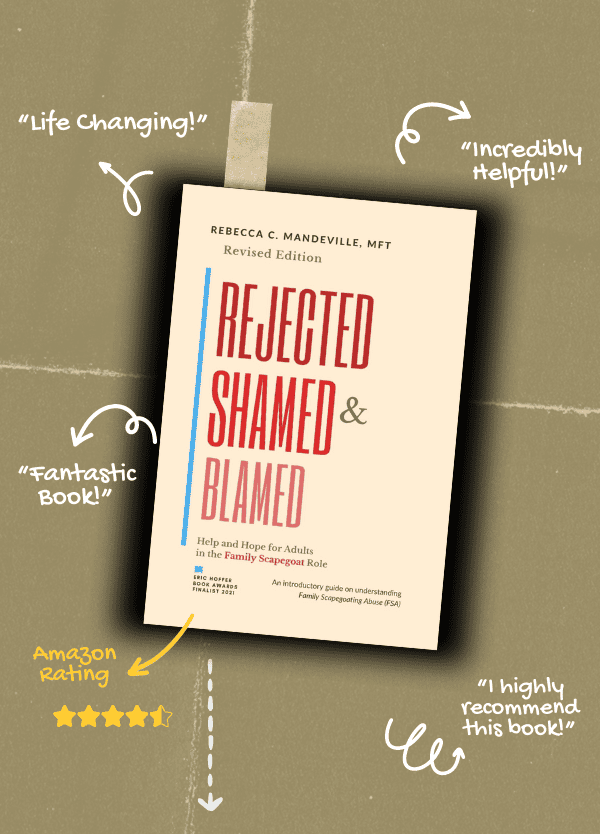
Since publishing my book on what I named Family Scapegoating Abuse (FSA)™ (Rejected, Shamed, and Blamed), which was a result of my original Family Systems research, many FSA adult survivors have written to me privately saying things like, “I can’t believe what I am reading – It’s like you’re writing about my own life!”
My knowledge of family scapegoating dynamics is based in part on countless hours spent working with both individuals and families in residential treatment settings and in my private practice for the past 20 years, as well as my qualitative research findings on what I eventually named ‘Family Scapegoating Abuse’, or ‘FSA’ – a type of abuse that is similar to narcissistic abuse but has its own unique features, as described in previous articles and in my introductory book on FSA. Given I have experience being in the ‘scapegoat’ role in my family-of-origin, my clinical work is informed by my personal experience of family scapegoating’s negative impact on child victims and adult survivors as well.
Today the term Family Scapegoating Abuse (FSA) is being used within various academic and clinical settings worldwide in support of continued research on this poorly understand form of systemic abuse. Read my article Why Family Scapegoating Abuse (FSA) Merits Global Attention to learn more.
Want to cite my work in your personal or commercial project? Scroll to the bottom of this post for information on Permission Requests.
Read my most recent published peer-reviewed quantitative studies on FSA here:
https://oapub.org/hlt/index.php/EJPHS/article/view/202/202
https://oapub.org/hlt/index.php/EJPHS/article/view/232/232
Many of those writing to me express the intensity of emotions they experience when recognizing themselves as FSA survivors. Typical comments include, “At last, there’s a name that describes what I’ve been experiencing,” and “Now that I understand what may have happened to me, I have hope that perhaps there’s a way for me to recover.”
Often those reaching out to me to share their experiences of being scapegoated also have a lot of questions about family scapegoating abuse as related to their experiences of painful and damaging family betrayal. Unfortunately, many of these adult survivors have been exposed to non-robust and a times fictional information about family scapegoating and its effects from self-proclaimed social media influencers posing as ‘experts’, making their recovery and healing process that much more challenging (read my article The Dangers of Confusing Fact with Fiction When Discussing Family Scapegoating Abuse to learn more.)
“Rebecca C. Mandeville’s pioneering research on the systemic phenomenon she named Family Scapegoating Abuse (FSA) marks the establishment of a new – and critically important – area of study within the field of Family Systems. At last, survivors of this devastating phenomenon have names and terms to describe what happened to them in their family and a means of moving forward in their healing and recovery process.” – Joshua Mitchell, PhD, LMHC
the Problem of Conflating Narcissistic Abuse With Family Scapegoating Abuse (FSA)
In the expanding landscape of trauma recovery and mental health awareness, terms like “narcissist” and “scapegoat” have entered the mainstream lexicon. While this increased visibility is vital, it has inadvertently birthed a pervasive myth: The belief that Family Scapegoating Abuse (FSA) is exclusively a symptom of Narcissistic Personality Disorder. This reductionist view does a profound disservice to survivors. As detailed in my introductory book on FSA, Rejected, Shamed, and Blamed, family scapegoating is not merely a weapon of the narcissist; it is a systemic mechanism utilized by any dysfunctional family unit seeking homeostasis. Whether driven by addiction, mental illness, personality disorders, individual and/or intergenerational trauma, or rigid authoritarianism, the act of selecting an “Identified Patient” serves a specific function: to manage the collective anxiety of the group. To truly understand and heal from FSA, we must look beyond the personality of the parent and examine the architecture of the system itself.
Here is an analysis of that distinction—why scapegoating is a systemic tool, not just a narcissistic weapon—and why broadening the definition is vital for proper treatment and understanding.
1. Scapegoating as a Systemic “Pressure Valve”
As has been revealed in research occurring within the field of Family Systems on the ‘Identified Patient’, scapegoating is a structural necessity in many types of dysfunctional families, not just narcissistic ones. The “Identified Patient” is created to manage anxiety within the group, regardless of the source of that anxiety.
If we remove the “narcissist” from the equation, we can see how FSA manifests in other toxic systems:
- Addiction Systems (Alcoholic/Substance Use): In families battling addiction, the scapegoat is often the “truth-teller” or the one who refuses to participate in the denial. The system attacks them not out of narcissistic malice, but to protect the secret of the addiction. The scapegoat distracts attention away from the addict.
- Rigid/Authoritarian Systems: In ultra-religious or culturally rigid families, the scapegoat is often simply the child who is “different” (neurodivergent, LGBTQ+, or artistically inclined). The system purges them to maintain its rigid definition of “purity” or “success.” This is driven by fear and conformity, not necessarily NPD (Narcissistic Personality Disorder).
- Generational Trauma & Emotionally Immature Parents: Parents with unresolved trauma may project their own “shadow” (repressed anger, shame, or fear) onto a child. They aren’t trying to destroy the child to feed an ego (as a narcissist might); they are unconsciously using the child as an energetic container for feelings they cannot regulate themselves.
2. The Danger of the “Narcissism Only” Narrative
When “experts” insist that scapegoating is strictly a symptom of Narcissistic Abuse, it creates several problems for the victim:
- Misdiagnosis of the Dynamic: If a survivor looks for a “narcissist” parent and can’t find one (perhaps the parents are simply emotionally stunted, depressed, or overwhelmed), the survivor might convince themselves into erroneously thinking, “It wasn’t abuse because my mom isn’t a narcissist.”
- Ignoring the Enablers: In a narcissistic model, the focus is heavily on the perpetrator. In an FSA / Family Systems model, the focus is on the entire cast—the enablers, the bystanders, and the “Golden Child”—who all participate in the shunning to maintain their own safety.
- Intent vs. Impact: Narcissism implies a level of calculated malevolence or extreme entitlement. Other forms of dysfunction (like untreated mental illness) can lead to scapegoating that is reactive and chaotic rather than calculated. The damage to the scapegoat is the same, as revealed by my original FSA research (C-PTSD; Betrayal Trauma; etc.), but the root cause is different.
3. FSA is a Structural Mechanism, Not a Personality Trait
My research emphasizes that FSA is a systemic distortion. It is about how the family unit organizes itself to survive.
- The Narcissist uses scapegoating to prop up their false self.
- The Addict uses scapegoating to protect their supply.
- The Trauma-Impacted Family uses scapegoating to manage overwhelming anxiety.
The mechanism (blaming one person) is the same, but the engine driving it varies. By recognizing this, we validate the pain of survivors who come from families that were “dysfunctional”, “chaotic”, or “rigid” but not necessarily “narcissistic.”
Ultimately, disentangling Family Scapegoating Abuse from the strict confines of Narcissistic Abuse is not just a matter of semantic accuracy—it is a prerequisite for survivor validation. When we acknowledge that scapegoating is a structural “pressure valve” rather than solely a narcissistic trait, we open the door for survivors of addiction-based, trauma-impacted, and emotionally immature family systems to finally recognize their own lived experiences. The damage inflicted by a chaotic or rigid system is just as real as that inflicted by a malignant one. By shifting the focus from the “villain” to the “system,” we empower survivors to stop searching for a specific diagnosis in their parents to justify their pain, and instead focus on the reality of the systemic dysfunction that shaped them. The abuse was real, regardless of the engine that drove it.
Below are five of the most frequently asked questions I am asked that are critical to understanding Family Scapegoating Abuse and its effects
1 – What Is the ‘Family Scapegoat’? ‘The Scapegoat’ is one of the roles unconsciously ‘assigned’ to a child growing up in a dysfunctional or narcissistic family system. In a dysfunctional family system, the scapegoating may be fueled by unconscious systemic anxiety, intergenerational trauma, and the Family Projective Identification Process. Alternatively, in a narcissistic family system, whereby a parent or other dominant family member is highly narcissistic, has Narcissistic Personality Disorder (NPD), or is a malignant narcissist, the scapegoating can be severe, deliberate, conscious, and intentional and the Family Projective Identification Process may or may not be involved. The scapegoating of a particular family member typically (but not always) begins in childhood and often continues into and throughout adulthood, although the role may be passed around to different family members at times.
Because family scapegoating processes can be insidious and subtle, many adult survivors do not realize that they are suffering from a most egregious (and often chronic) form of systemically-driven psycho-emotional bullying and abuse, with all of the painful consequences to body, mind, and spirit.
More specifically: Children and adult children who are caught in the ‘family scapegoat’ role are the ‘Identified Patient’ (IP) in their family. As such, they are often the targets of what I call the ‘scapegoat narrative’, i.e., a ‘shaming and blaming’, distorted family narratives (aka ‘smear campaigns’) and can end up rejected and discarded by those who were supposed to love and care for them the most: Their family-of-origin.
2 – Why Do Families Scapegoat? Research suggests that parents who are mentally ill or emotionally unstable (including those who have a personality disorder, such as Borderline Personality Disorder or Narcissistic Personality Disorder) are far more likely to scapegoat their child than a psycho-emotionally healthy and stable parent. This is why it is extremely important to be aware of the fact that family scapegoating can occur in ANY type of dysfunctional family system, not just a narcissistic one.
Such parents may attack their child to release their pent up frustrations and deep feelings of abandonment, ‘toxic shame’, or self-hatred. They might engage in ‘splitting’ behaviors as well, e.g., they might pit one sibling against the other to create a camp of ‘allies’. Parents that ‘split’ will also tend to see one child as ‘good’ (the ‘golden child’) and another as ‘bad’ (the ‘scapegoat’).
In Family Systems theory, scapegoating in a dysfunctional (not narcissistic) family system is understood to be fueled by unconscious processes (specifically, the Family Projective Identification Process) whereby the family displaces their own collective psychological difficulties and complexes onto a specific family member.
This does not mean that all acts of scapegoating in a dysfunctional family system (i.e., rejecting, humiliating, blaming, and shaming) are unconscious – rather, the projective identification process fueling the scapegoating of the family member is unconscious (and, as mentioned above, is often rooted in, and fueled by, intergenerational trauma) .
This process of projection, shaming, and blaming serves to divert attention away from the rest of the family’s mental and emotional problems via casting the targeted family member into the role of ‘scapegoat’. It is sometimes the case that families who scapegoat one of their own are oblivious to the fact that they are engaging in psycho-emotional abuse and will become highly defensive if this is pointed out.
In a narcissistic family system, the scapegoating is driven by a narcissistic family power-holder – typically a parent but at times a grandparent or other power-holding family member (such as a dominant ‘golden child’ sibling). This family member may have strong narcissistic traits, Narcissistic Personality Disorder (NPD) or may even be a malignant narcissist with antisocial, sadistic traits. In such cases, the scapegoating abuse is typically conscious, malicious, and intentional.
Despite the fact that the ‘family scapegoat’ role is common to dysfunctional and narcissistic families, there is surprisingly little research or literature available to both lay-person and clinician describing family scapegoating’s features and effects on the targeted child / adult child. As a result, family scapegoating is seldom recognized as abuse warranting clinical intervention and treatment
3 – What Are the Effects of Family Scapegoating Abuse (FSA)? Many FSA adult survivors fail to realize that they have actually suffered from a form of systemic psycho-emotional abuse growing up, and even their therapist or counselor might miss the signs and symptoms associated with being in this most devastating dysfunctional family role.
Specifically: Adults seeking assistance from a mental health professional may find that the genuine pain and distress they are experiencing is minimized or even invalidated (e.g., “But they’re your family, of course they love you”; “Family connections are so important, it can’t be that bad”; “It’s best if you forgive, we need to maintain ties with our family to be healthy”), which only serves to reinforce the scapegoated adult’s fear that they are somehow fundamentally to blame for their strained (or non-existent) family relationships.
As a consequence of having their family relational distress and abuse symptoms go unrecognized, many adult survivors of FSA suffer from anxiety, panic attacks, depression, and anger management issues. They may have been diagnosed in the past with Generalized Anxiety Disorder, Major Depressive Disorder, Attention Deficit Hyperactive Disorder (ADHD), Bipolar Disorder, Obsessive-Compulsive Disorder (OCD), and Agoraphobia. Others may be diagnosed with a personality disorder (Borderline Personality Disorder, especially), or an attachment disorder. They also will often present with codependency (which can actually be the trauma response of ‘fawn/submit’) and/or addiction. Rarely, however, will a practitioner recognize the need to assess for complex trauma (C-PTSD) and structural dissociation (primary or secondary type), which is what many FSA adult survivors are actually suffering from.
4 – Can Family Scapegoating Abuse Lead to Complex Trauma?
Yes. It has been my observation that in addition to being diagnosed with one or more of the disorders listed above, many family scapegoating abuse survivors are suffering from symptoms of undiagnosed, untreated Complex post-traumatic stress disorder (C-PTSD) – a fact that I discuss at length in my book on FSA, Rejected, Shamed, and Blamed. It can also lead to what I named Family Scapegoating Trauma (FST), which I will be discussing in future articles.
As related to my ongoing work with adult survivors seeking to recover from family scapegoating abuse, it is my experience that the rejecting, shaming, and otherwise non-nurturing, harmful, and abusive family environment my clients grew up in (and had no means of escaping from) has actually contributed to their experiencing symptoms of Complex post-traumatic stress disorder (C-PTSD – which is also known as complex trauma disorder) secondary to chronic parental / family psycho-emotional (and at times physical) abuse.
My FSA research also suggests that Family Scapegoating Abuse can also result in the adult survivor experiencing profound betrayal trauma symptoms; toxic shame; disenfranchised grief; and traumatic invalidation.
5 – What’s One of the Biggest Obstacles to FSA Recovery? Scapegoated adults often don’t realize how their familial distress has been negatively impacting nearly every area of their life, including their mental and emotional health, relationships, work, and their ability to realize their most cherished goals and dreams.
For example, scapegoated adults often feel debilitated by self-doubt and ‘Impostor Syndrome’ in their relationships and in the work-place, and blame themselves for their difficulties. They typically struggle in regard to creating and experiencing a sense of life mission, passion, and purpose, and find themselves succumbing to feelings of futility, hopelessness, depression, anxiety, and despair. In extreme cases they may feel that taking their own life is the only way to end their pain, as they see no way to rectify their situation or heal from the grave injustices done to them.
What the FSA victim may see as ‘family conflict’ is often unrecognized mental and emotional abuse (which today is at times referred to as ‘hidden’ or ‘invisible’ abuse). To compound matters further, the FSA victim typically doesn’t realize how being the target of family scapegoating is affecting their ability to succeed and thrive in their personal and professional life.
It simply is not possible to recover from something if we do not know what we are trying to recover from. This is why educating adult survivors and Mental Health professionals regarding the reality of FSA and its devastating effects is critical at this time.
Learn about my book on Family Scapegoating Abuse

ATTENTION:
🛑 Important Notice Regarding use of My Intellectual Property
Thank you for visiting, sharing, and engaging with the resources on this site! Your support in raising awareness about Family Scapegoating Abuse (FSA) is highly valued.
Please be aware that the specific term, concept, and content surrounding ‘Family Scapegoating Abuse’ (FSA) have been developed, researched, and copyrighted by Rebecca C. Mandeville, founder of Family Scapegoating Abuse (FSA) Education.
Why Permission is Needed to Use My FSA Content
I ask that you respect my intellectual property rights for the following reasons:
- Protecting Integrity: My materials, including the term ‘Family Scapegoating Abuse (FSA), are designed to provide specialized, reliable, and consistent information and resources. Unauthorized use or modification can dilute the term’s meaning and potentially misrepresent the underlying research-supported concepts.
- Copyright Protection: All original text, articles, structure, and the specific application and definition of Family Scapegoating Abuse (FSA) are protected under copyright law.
How to Share and Use My FSA Work Appropriately
- Attribution is Required: If you reference or quote the concept, definition, or specific term Family Scapegoating Abuse (FSA) in a non-commercial work and your quote is 100 words or less, please provide clear and visible credit back to me and this website. *Example: “The concept of Family Scapegoating Abuse (FSA) as defined here is based on the work of clinician and researcher Rebecca C. Mandeville at https://www.scapegoatrecovery.com.”
- Use for Personal Awareness: You are encouraged to use the concepts for personal understanding and discussion for non-commercial purposes, using the above attribution.
- Commercial/Public Use Requires Permission: You must obtain explicit, written permission from me before using the term Family Scapegoating Abuse / FSA or any content derived from this site for:
- Any commercial purpose (e.g., in a book, paid course, or for-profit resource).
- Public distribution or publication (e.g., in a non-accredited educational resource, blog post, or training material) that goes beyond simple reference and attribution.
EMAIL ME FOR PERMISSION: I’m passionate about helping people understand and recover from FSA. If you plan to create commercial or non-commercial content (articles, podcasts, books, videos, etc.) that references Family Scapegoating Abuse and/or FSA and/or my FSA research and related content and educational material, you must email me to request permission to use my copyrighted work (this includes translations of my content).
Thank you for your understanding and cooperation in protecting my ability to continue developing and sharing these vital resources. – Rebecca C. Mandeville, LMFT, CCTP
Copyright 2020 – 2025 | Rebecca C. Mandeville | All Rights Reserved

Contact Author for Permissions for quotes over 100 words