
By Rebecca C. Mandeville, LMFT, CCTP
Founder, FSA Education & Research
Post Status: Public
Included Video: FSA Public Service Announcement (PSA)
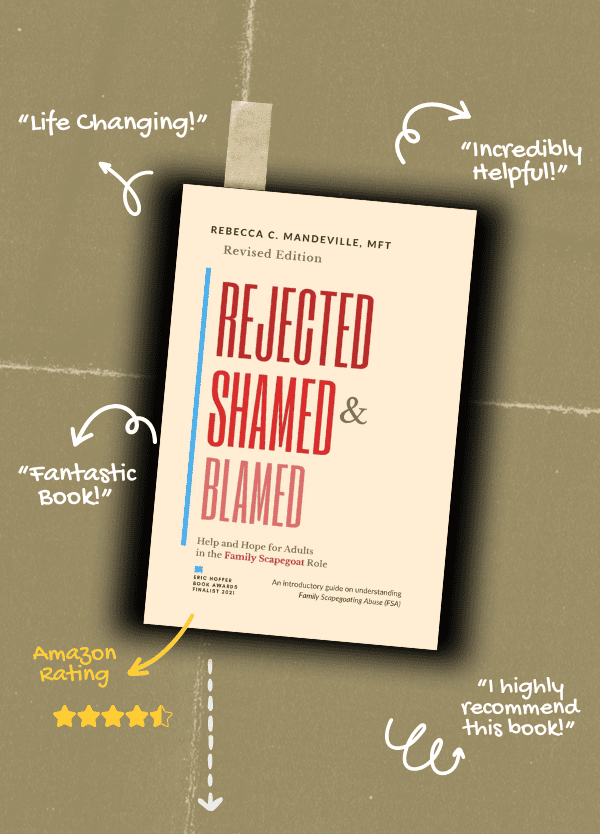
Included Book Link: Rejected, Shamed and Blamed
“I can’t believe what I am reading—it’s like you’re writing about my own life.”
Dear Subscribers,
Since I first named and published my research on Family Scapegoating Abuse (FSA), I have received this message from thousands of adult survivors worldwide. For many, discovering this term is the first time they have felt truly “seen” by the clinical world.
What is Family Scapegoating Abuse (FSA)?
Family Scapegoating Abuse is a systemic form of “invisible” (psycho-emotional) abuse where a family unit unconsciously assigns the role of “Identified Patient” (IP) to a specific member. This individual becomes the “container” for the family’s collective shame, anxiety, and unresolved trauma – both individual and intergenerational.
While often confused with Narcissistic Abuse, my 20 years of clinical work, qualitative research, and peer-reviewed (published) quantitative studies have proven that FSA is a unique systemic phenomenon. It is a structural “pressure valve” used by dysfunctional family systems to maintain a false sense of stability, or “homeostasis”. (Note: Scapegoating in families can also be conscious and intentional, particularly when it is driven by a narcissistic parent, as described in my article on narcissistic family systems.)
The Systemic Engine: Why Families Scapegoat
A pervasive myth exists that scapegoating only happens in families where there is a narcissistic parent. My pioneering research, detailed in my introductory book on FSA, Rejected, Shamed, and Blamed, reveals a deeper truth: FSA is frequently a mechanism of the system, not just a personality trait of a parent, sibling, or other scapegoating family members.
The “engine” driving the abuse varies, but the impact on the survivor is the same:
- Addiction Systems: The scapegoat is the “truth-teller” who threatens the family’s denial.
- Rigid/Authoritarian Systems: The scapegoat is the “different” or more “individualized” child / adult child (e.g., neurodivergent, LGBTQ+, or creative) who threatens the family’s demand for conformity.
- Projective Identification: Family members project their own “shadow” (repressed individual and ancestral ‘toxic’ shame or fear) onto a child as a means of emotionally regulating themselves.
- Intergenerational Trauma: Unprocessed intergenerational / ancestral trauma (wars, immigration, suicide, injury, illness, still births, and other traumatic forms of loss) permeates the family system and contributes to pathological Projective Identification processes.
By shifting the focus from the “villain” to the “system,” we empower survivors to stop searching for a specific diagnosis in their scapegoating family members so they can begin healing the reality of their lived experience.
The 5 Tenets of Family Scapegoating Abuse (FSA)
1. The “Identified Patient” Role
In dysfunctional and narcissistic family systems, the scapegoat is assigned the role of the “problem”. Your “native truth” is overwritten by the ‘scapegoat narrative’—a distorted family “script” of shaming and blaming that often results in being rejected or discarded by those meant to love and protect you.
2. The Unconscious “Pressure Valve”
In many families, this process is fueled by Family Projective Identification. The family displaces their collective psychological complexes onto you to avoid facing their own pain. In narcissistic family systems, however, this process can be conscious, malicious, and intentional.
3. The “Invisible” Effects of FSA
FSA is a form of “hidden” abuse. Because it is often subtle and insidious, even experienced therapists can miss the signs. Survivors are frequently told by health professionals and even their close friends to “just forgive,” “get over it,” or “keep the peace,” which only compounds their experience of Traumatic Invalidation.
4. The Link to Complex Trauma (C-PTSD)
My original qualitative research revealed that chronic scapegoating is a primary driver of Complex Post-Traumatic Stress Disorder (C-PTSD) and Betrayal Trauma in targets of FSA. It also can lead to structural dissociation, “fawn/submit” responses (often mislabeled as codependency), and profound toxic shame. My findings were further confirmed by my latest (co-authored) peer-reviewed study that revealed FSA causes Autonomic Nervous System (ANS) dysfunction.
5. The Path to Recovery
Recovery is impossible if you don’t know what you are needing to recover from. My work focuses on educating both survivors and clinicians on the reality of FSA, providing a coherent, research-backed map out of the “scapegoat role” and into your “inviolate,” sovereign Self.
Learn More About FSA
- Read the Peer-Reviewed Research Findings
- Explore the FSA Healing Approach
- Get the Book: Rejected, Shamed, and Blamed
- Visit my FSA Education & Research website.
Read my most recent published peer-reviewed quantitative studies on FSA here:
https://oapub.org/hlt/index.php/EJPHS/article/view/202/202
https://oapub.org/hlt/index.php/EJPHS/article/view/232/232
FSA Public Service Announcement – Short and Easy to Share!
https://www.youtube-nocookie.com/embed/ar426kSxEE4?rel=0&autoplay=0&showinfo=0&enablejsapi=0
Learn About My Book on
Family Scapegoating Abuse