
Tag: Invisible Abuse
-

The 5 Tenets of Family Scapegoating Abuse (FSA): The Power of Naming the Unseen.
While often confused with Narcissistic Abuse, my 20 years of clinical work, qualitative research, and peer-reviewed (published) quantitative studies have proven that FSA is a unique systemic phenomenon. It is a structural “pressure valve” used by dysfunctional family systems to maintain a false sense of stability, or “homeostasis”.
-

Beautiful Scars: What the Art of Kintsugi Can Teach Us About Healing From Family Scapegoating Abuse (FSA)
The ancient Japanese art of Kintsugi beautifully illustrates the concept of embracing imperfections and turning brokenness into beauty. Versus feeling self-conscious or a sense of shame or inferiority as related to their intrapsychic wounds and scars, adult survivors of family scapegoating abuse (FSA) may benefit by re-envisioning their healing process from family trauma and abuse…
-

Scapegoating, Narcissism, and Reactive Abuse
Reactive abuse is when someone who is a victim of abuse (family scapegoating abuse, in this case) reacts to the abuse in such a manner that if an outside person were to be a fly on the wall observing, it would make it look like they, and not the perpetrator, are the abuser.
-
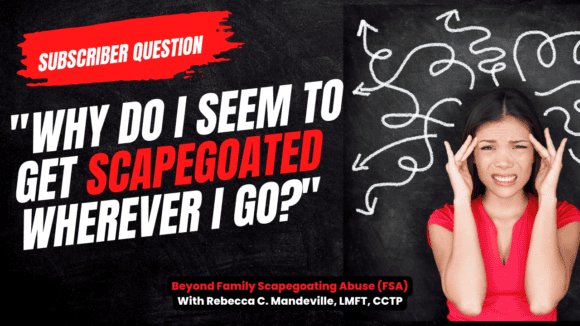
“Why Do I Seem to Get Scapegoated Wherever I Go?
New Vlog Release – and announcing a new series on YouTube on my new Beyond Family Scapegoating Abuse Channel, Subscriber Question of the Week: This week’s subscriber question is, “Why do I seem to find myself in the ‘scapegoat’ role wherever I go?”
-
Family Scapegoating Abuse (FSA) Public Service Announcement – Now Available on YouTube
I’m sharing a short video clip excerpted and re-worked for my own use from a PSA I was asked to create for a Mental Health organization regarding the effects of family scapegoating abuse on children and adult survivors, as identified via my FSA research. To facilitate sharing, I have started an FSA Education YouTube channel…