Blog
Popular Articles
-

“Invisible Scars”: Recognizing Family Scapegoating Abuse (FSA) During National Child Abuse Prevention Month
•
For over two decades, my work has focused on defining and documenting the insidious phenomenon I named ‘Family Scapegoating Abuse’ (FSA)—a systemic process where a child is drafted into the role of the “Identified Patient,” “Black Sheep,” or “Problem Child” to “ground” the unprocessed trauma and anxiety running on the energetic family “grid.”
-

Beyond the ‘Identified Patient’: The Structural Reality of Family Scapegoating Abuse (FSA)
•
Family Scapegoating Abuse may lead to the creation of the IP in families, but it is certainly not passive. It is instead a dynamic, targeted, active and persistent mechanism of systemic identity overwrite and attempted erasure.
-

The 5 Tenets of Family Scapegoating Abuse (FSA): The Power of Naming the Unseen.
•
While often confused with Narcissistic Abuse, my 20 years of clinical work, qualitative research, and peer-reviewed (published) quantitative studies have proven that FSA is a unique systemic phenomenon. It is a structural “pressure valve” used by dysfunctional family systems to maintain a false sense of stability, or “homeostasis”.
-

Family Scapegoating Abuse (FSA): A Summary of Peer-Reviewed Research and Clinical Validation
•
The field of trauma and family systems theory has reached a critical inflection point, driven by the quantitative evidence emerging on the insidious systemic phenomenon I named Family Scapegoating Abuse (FSA). This archive serves to present the key findings from the high-impact peer-reviewed studies co-authored with Dr. Kartheek R. Balapala and his team of research scholars, in…
-

The Evolution of FSA Recovery: Launching Our Third Zambia-Based Clinical Study
•
Our most recent (2nd) quantitative study proved just the opposite. By measuring heart rates and blood pressure in relation to being scapegoated by family, we demonstrated that FSA is a physiological assault. When you are caught in what I call the “Blame-Storm”—where your family pelts you with projections and lies—your body reacts as if it is under…
-

The Scapegoat Solution™ Online Masterclass Waiting List
•
Through my Kintsugi Method for FSA Recovery™, I focus on the “Golden Repair” of the shattered identity—reconstructing the vessel so it can finally contain the light of your “Inviolate” (or “True”) Self. This is the realization of a Core Constancy within an identity structure that the family system can no longer reach or influence.
-
Critical Research Findings That Affirm the Reality of Family Scapegoating Abuse (FSA) Survivors
•
The field of trauma and family systems theory has reached a critical inflection point, which has in part been driven by the quantitative evidence emerging on the insidious systemic phenomenon I named Family Scapegoating Abuse (FSA). This post serves to consolidate and present the key findings from FSA research studies to date conducted by…
-

Family Scapegoating Abuse (FSA) Education Has Moved to Substack!
•
Hi everyone, It’s been a long time since I’ve written to you from this Scapegoat Recovery WordPress site. Last year, my entire Subscriber list disappeared from my WordPress site – This was related to a plugin I was using at WordPress’s recommendation. I therefore moved my Newsletter over to Substack last June, but couldn’t…
-

First Peer-Reviewed Quantitative Research Study Published on Family Scapegoating Abuse (FSA)
•
The first peer-reviewed quantitative research study on Family Scapegoating Abuse (FSA) will soon be published – Rebecca C Mandeville will be named as co-author / affiliate on this publication. The study was based on her original research tools that she developed when conducting qualitative studies over the past 15-plus years on the family systems phenomenon she named ‘Family…
-

What Happens When We Weaponize the Term ‘Narcissist’
•
Navigating life after abuse can be a minefield for adult survivors, where every hurtful encounter might trigger memories of past trauma. In recent years, there’s been a notable trend among survivors engaging on social media and online support forums to quickly label those who cause them harm as narcissists. While this reaction may stem…
-
The FSA Newsletter Is Moving to Substack! Enjoy Ad-Free Access, Subscriber Upgrades, and Community Features
•
Due to a technical glitch I have not been able to resolve, I am no longer able to email my articles out to subscribers from WordPress. My hope is that some of you will visit my blog and find my post to you here. If you’d like to receive all of my new content…
-

Why Family Scapegoating Abuse (FSA) Merits Global Attention
•
In the intricate tapestry of family dynamics, there exists an overlooked, devastating phenomenon concealed in shadows – Family Scapegoating Abuse (FSA). FSA is like a silent, insidious stalker that preys upon vulnerable family members, leaving deep scars that often go unnoticed and unrecognized. In this article, clinician and researcher Rebecca C. Mandeville addresses why…
-

Dirty Secrets: The Hidden Truth of Mobbing and Betrayal Trauma in Families That Scapegoat
•
In the labyrinth of family dynamics lies a dark underbelly often veiled by the facade of harmony and love. Betrayal Trauma, Family Mobbing, and Family Scapegoating Abuse (FSA) are three interwoven phenomena that thrive in the shadows of familial relationships, leaving deep scars on the psyche of those ensnared within their grasp…
-

Breaking the Silence: The Challenge of Mother’s Day for Family Scapegoating Abuse (FSA) Survivors
•
For adult survivors of Family Scapegoating Abuse (FSA), Mother’s Day can serve as a reminder of the deep wounds inflicted by familial dynamics gone awry….
-

FSA and Family Mobbing: Dynamics, Impact, and Coping Strategies
•
Family, typically regarded as a sanctuary of love and support, can sometimes harbor complex dynamics that lead to unexpected forms of conflict and distress, as well as covert or overt forms of individual and/or systemic abuse. One such phenomenon that qualifies as systemic abuse is family mobbing, a term often associated with workplace bullying…
-

Beautiful Scars: What the Art of Kintsugi Can Teach Us About Healing From Family Scapegoating Abuse (FSA)
•
The ancient Japanese art of Kintsugi beautifully illustrates the concept of embracing imperfections and turning brokenness into beauty. Versus feeling self-conscious or a sense of shame or inferiority as related to their intrapsychic wounds and scars, adult survivors of family scapegoating abuse (FSA) may benefit by re-envisioning their healing process from family trauma and…
-

When We Question the Competence and Qualifications of Women
•
Summary: Women often face heightened scrutiny and obstacles in having their qualifications and skills recognized and valued compared to men due to societal biases and internalized misogyny. This issue stems from ingrained gender stereotypes and a lack of inclusive environments that support gender equality. In this article, Rebecca C. Mandeville reflects on women, marginalization,…
-

Sibling Estrangement: The Impact of Family Scapegoating Abuse (FSA) on Sibling Relationships
•
Scapegoating in dysfunctional or narcissistic families disrupts family bonds and may lead to sibling estrangement. A break in sibling bonds is especially likely when one or more siblings adopt the damaging ‘scapegoat narrative’ used to devalue and depower the child in the ‘family scapegoat’ role.
-

Recovering From Narcissistic Family Abuse
•
Learn the 11 guiding principles I share with my FSA recovery coaching clients to support healing from Narcissistic Family Scapegoating Abuse (FSA).
-

Radical Acceptance and Scapegoat Recovery: The Power of Accepting What IS
•
Releasing attachment to highly charged emotions and events does not mean that one is “giving up” on themselves or “giving in” to abuse from others. It is simply a process that supports people in coping with past and/or current life circumstances that cannot be changed and that they are powerless over.
-
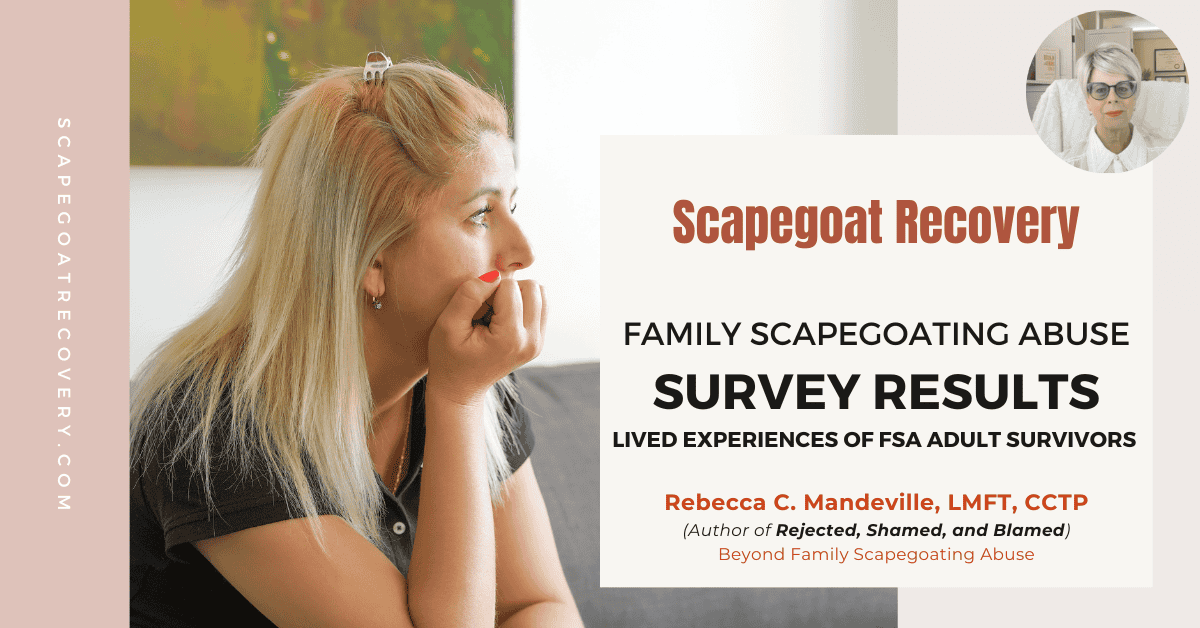
Key Findings From My Recent FSA Survey (2023)
•
As some of you participated in my first FSA Resesarch Survey of 2023, I am sharing a short video that focuses on a few key findings resulting from this survey.
-

Why This Key Malignant Narcissist Trait Can Fool Scapegoat Survivors
•
Adult Survivors of Family Scapegoating Abuse (FSA) who are also Empath-types can be particularly vulnerable to the manipulative tactics of the malignant narcissist. In today’s article, I share a key trait that a malignant narcissist exhibits that can draw vulnerable FSA adult survivors into their deadly web – a trait that defies commonly held…
-

-
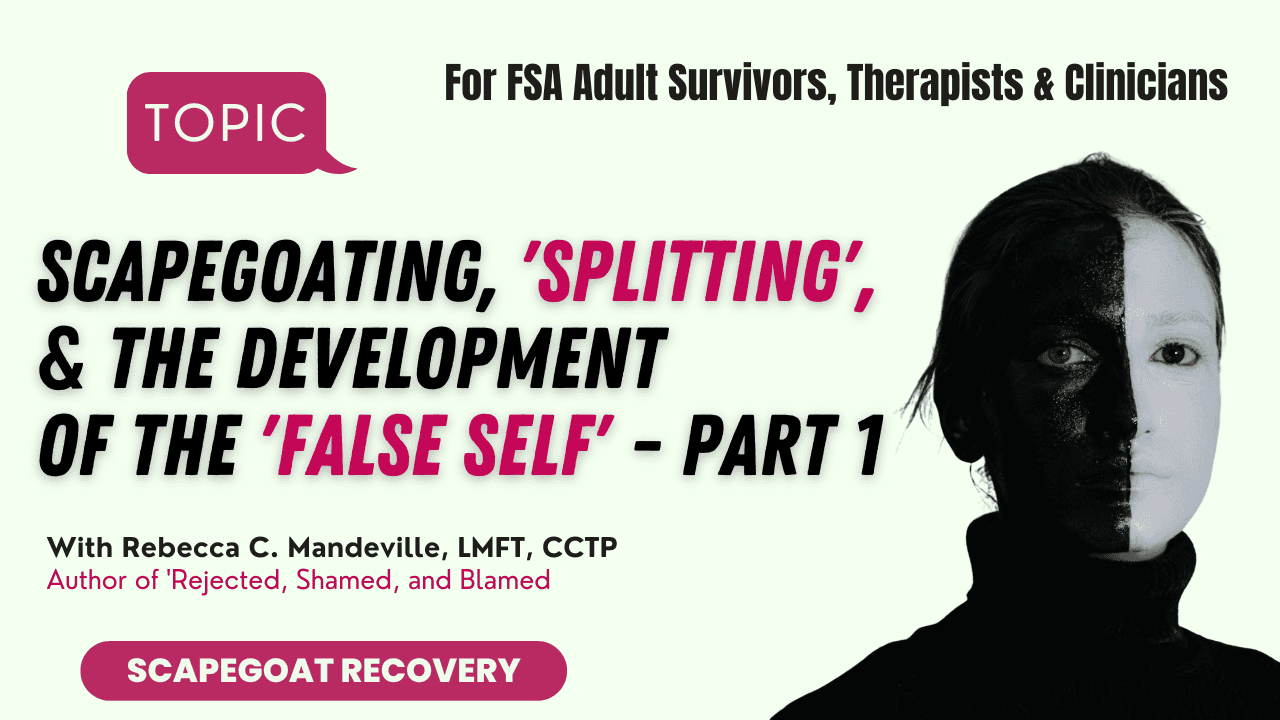
How the Scapegoat Child Develops a ‘False’ Self
•
An important, sometimes even critical, aspect of recovering from family scapegoating abuse (FSA) is to recognize that you may have developed a ‘false’ or ‘survival’ self very early in life to survive a hostile or threatening family environment.
-

Cutting Ties With Scapegoating Family: A Trauma-Informed View
•
In this week’s article I share one of the biggest myths about going no contact with family and how I handle issues related to ending contact with scapegoating family members in a trauma-informed manner.
-

Family Scapegoating Abuse and Structural Dissociation: Healing the Fragmented Self
•
In this article, I share several signs of Structural Dissociation that Family Scapegoating Abuse Adult Survivors and Mental Health providers need to be aware of to ensure successful treatment of this most egregious form of ‘invisible (psycho-emotional) abuse.
-

6 Clinical Signs of Family Scapegoating Abuse (FSA)
•
To recover from something, you need to understand what you’re trying to recover from. In this week’s article, I discuss the clinical consequences of being scapegoated by your family that I have identified via my research on what I named ‘Family Scapegoating Abuse’ (FSA) and in my trauma-informed Coaching and Psychotherapy practices. If you…
-

Ten Transformative Affirmations for Scapegoat Recovery
•
Announcing my inclusion in the new YouTube Health Partner Program and the release of Affirmations for Scapegoat Recovery, Volume Two…
-

Scapegoating in Narcissistic Family Systems
•
My latest video on narcissistic families and scapegoating explores family systems that are dominated by a narcissistic parent. This would be a parent that meets the criteria for Narcissistic Personality Disorder or who displays strong narcissistic traits.
-
What Is Family Scapegoating Abuse (FSA)?
•
It’s been very rewarding to see that therapists and Mental Health clinics are now adopting the term family scapegoating abuse and releasing articles on FSA to educate others. I will continue to speak out on family scapegoating abuse whenever I am asked as I advocate for those whose psycho-emotional health has been negatively impacted…
-
Scapegoat Recovery and Recognizing Damaging Unspoken Family Rules
•
A Warm Welcome to Our New Subscribers! I’ve posted a new video on 10 UNSPOKEN FAMILY RULES that support family scapegoating abuse (FSA) dynamics for you to check out when you have time – Chapters are included beneath the video link both here and on YouTube in the video description. When you click on…
-

FSA Updates as We Enter a New Year…
•
Beginning a new year provides an opportunity to release what no longer serves us, which allows us to both embrace and pursue what now does. Many of my FSA recovery coaching clients have shared with me that they are experiencing a mix of both grief and hope as they enter 2023 – and also…
-
Online Speaker Summit: Access Top-Notch Interviews (Including Mine) – For Free!
•
I’m pleased to be able to offer you free access to a series of interviews from an online conference I participated in hosted by Fork in the Road with Sheree Clark. Although this virtual conference has a Women’s Midlife theme, many of the speakers and topics may be of interest to subscribers of my…
-

FSA Digest – Complete Podcast and Holiday Resources
•
This end-of-year digest includes the complete ‘Adult Child’ podcast interview I recently did, as well as an interesting abstract and holiday resources.
-
Scapegoating in Dysfunctional versus Narcissistic Family Systems, Podcast, and Holidays
•
Andrea Ashley and I have been getting some terrific feedback on the podcast we did recently on her show, Adult Child Podcast. I know some of you have been waiting for it to be available on YouTube. Parts One and Two of the interview are now posted there, with closed captions and chapter segments…
-

FSA in the Media: New Podcast and Two New Videos
•
This was a busy week: I participated in two podcast interviews and shot two new videos for my new YouTube channel, Beyond Family Scapegoating Abuse…
-

The Empath Truth-Teller, Family Scapegoating, and Sibling Estrangement (2 New Videos)
•
This week on Beyond Family Scapegoating Abuse (YouTube) I address two topics pertaining to family scapegoating abuse (FSA): Family Empaths and Sibling Estrangement.
-
“Why Do I Seem to Get Scapegoated Wherever I Go?
•
New Vlog Release – and announcing a new series on YouTube on my new Beyond Family Scapegoating Abuse Channel, Subscriber Question of the Week: This week’s subscriber question is, “Why do I seem to find myself in the ‘scapegoat’ role wherever I go?”
-

Going Beyond Family Scapegoating Abuse (FSA)
•
“He says the best way out is always through. / And I can agree to that, or in so far / As that I can see no way out but through” -Robert Frost Just a quick heads up that I have recently uploaded two videos on my new FSA-focused YouTube channel (linked below). The…
-
3 Bizarre Realities Adult Survivors of Family Scapegoating Abuse Experience
•
I’ve started a new video series in which I describe the truly bizarre realities that adult survivors of family scapegoating abuse (FSA) experience, as revealed in my FSA research and clinical practice. Have any of these things happened to you or someone you know?
-
5 Myths About Family Scapegoating and Recovery
•
5 myths that adult survivors of family scapegoating abuse (FSA) need to know: It has been my experience, after assisting FSA adult survivors in their recovery for the past twenty years, that the five myths I’ve identified and am highlighting here in my latest video can impede one’s full healing from this most painful…
-
Ten Affirmations for Adult Survivors of Family Scapegoating Abuse
•
One of the greatest challenges faced by adult survivors of family scapegoating abuse (FSA) is the tendency to ruminate over past painful incidents with family or be consumed by feelings of low self-worth, shame, anger, or grief. I therefore decided to create my first video volume of affirmations to help FSA adult survivors ‘reset’…
-
Family Scapegoating Abuse (FSA) Public Service Announcement – Now Available on YouTube
•
I’m sharing a short video clip excerpted and re-worked for my own use from a PSA I was asked to create for a Mental Health organization regarding the effects of family scapegoating abuse on children and adult survivors, as identified via my FSA research. To facilitate sharing, I have started an FSA Education YouTube…
-

How Projection Processes Fuel Family Scapegoating Abuse
•
Healing from Family Scapegoating: Family scapegoating abuse (FSA) is a horrific form of ‘invisible’ (psycho-emotional) abuse fueled by an insidious family projective identification process. Unfortunately, even psychoanalytically-oriented therapists may not be familiar with the family projective identification process unless they have received in-depth training in Family Systems theory; hence, they will not be able…
-

The Fantasy “Repair” Experience of the FSA Adult Survivor
•
One of the things that keeps survivors of family scapegoating abuse (FSA) stuck and unable to progress in their recovery is the fantasy that if they can say the ‘right’ thing to the ‘right’ person within (or connected to) their family-of-origin, the fact of their abuse will be acknowledged and validated. Tragically, this is…
-
5 Reasons Your Family Won’t Apologize for Scapegoating You
•
Dysfunctional family systems are ‘closed’ systems that resist integrating information that threatens the accepted family narrative. Family members who have scapegoated you will rarely accept responsibility for their actions, despite how egregious their mistreatment of you has been. Below are five reasons why you are unlikely to ever receive an apology from your family…
-

10 Rules of Families That Scapegoat
•
A family that is dominated by a dysfunctional or narcissistic parent may result in its members living under a set of unspoken ‘rules’, rules which benefit the parent at the expense of their children’s well-being. The research I conducted on what I named family scapegoating abuse (FSA) suggests that dysfunctional families that scapegoat are…
-

Scapegoat Recovery: The Importance of Addressing Complex Trauma (C-PTSD)
•
Recovering from the traumatizing aspects of family scapegoating abuse (FSA) is an individual process and each FSA adult survivor’s healing journey will be unique. But no matter the recovery route you take, you will want to first ensure you build a strong foundation for recovery by addressing symptoms of complex trauma (C-PTSD).
-

Family Scapegoating Abuse, Complex Trauma, and Structural Dissociation
•
When FSA adult survivors are chronically traumatized within their family-of-origin, they can develop a form of dissociation known as structural dissociation, whereby the personality lacks integration and expresses itself through ‘parts’. But it is never too late to experience your innate wholeness…
-

The Scapegoat Child and the Malignant Narcissist Parent
•
For the child victim of family scapegoating abuse (FSA), the ‘scapegoat story’ created by one or both parents (which the entire family invariably adapts and accepts unquestioningly) can negatively impact their mental and emotional health. When a parent is a malignant narcissist, the abuse the child experiences can be extreme, resulting in complex trauma…
-

Healing From the Injustices of Family Scapegoating Abuse (FSA)
•
In the twenty years I have been working with adult survivors of family scapegoating abuse (FSA), one issue that typically becomes a ‘stuck’ point in their recovery journey is the sense of grave injustice they experience in regard to the wrongs done to them within their family-of-origin – Injustices that have never been acknowledged…
-

The Relationship Between Family Scapegoating Abuse (FSA) and Traumatic Shame
•
There are very few clients who enter my FSA Recovery Coaching practice who are not suffering from traumatic shame (also known as ‘toxic shame’), as well as a variety of complex trauma (C-PTSD) symptoms – something I discuss at length in my book, Rejected, Shamed, and Blamed. While traumatic shame creates a sense of…
-

Family Scapegoating Abuse (FSA) as Psychological Trauma
•
As we learn more about Complex Trauma (C-PTSD), it becomes increasingly clear that family scapegoating abuse (FSA) can lead to the development of C-PTSD symptoms, which are often misdiagnosed and mislabelled by Mental Health Professionals if and when the FSA adult survivor seeks therapeutic treatment and support.
-

Family Scapegoating Abuse and Healing the Mother Wound
•
Mother’s Day can be a particularly painful holiday for adult survivors of family scapegoating abuse (FSA), especially for those that are estranged from their nuclear family. Today’s article therefore focuses on mother wounding and transforming the ‘negative mother’ archetype.
-

Does Your Family Know They Are Scapegoating You?
•
A question I am often asked by clients and readers of my book, Rejected, Shamed, and Blamed, is whether or not family scapegoating abuse (FSA) is conscious and intentional or unconscious and unintentional. My answer is that it can be either or both, and that nothing is simple or black and white when it…
-

DARVO and Family Scapegoating Abuse (FSA): When the Abused Are Revictimized by Their Abuser
•
One of the more baffling and incomprehensible aspects of being scapegoated by family is being the target of mentally and emotionally abusive behaviors; reacting to the abuse appropriately (e.g., expressing hurt, confusion, anger, setting boundaries, etc), and then discovering that the person who committed the harmful or abusive acts views themselves as the victim…
-

The Healing Power of a ‘Victim Impact Statement’ for FSA Survivors
•
As you consider how being the victim of family scapegoating abuse has changed your life, you may use the following suggestions and questions to guide you. Do be aware that thinking and writing about something so painful may be difficult for you. Pace yourself and don’t feel that you need to complete your FSA…
-

When Your Family Invalidates Your Experiences of Abuse and Complex Trauma
•
It is difficult enough to bear the burden of traumatic childhood experiences and its long-term physical, emotional, and mental effects. For adult survivors of family scapegoating abuse (FSA), this difficulty is magnified by the fact that their reports of abuse or trauma are typically denied, dismissed, and invalidated by their family due to their…
-

10 Strategies for Navigating Holiday Family Gatherings
•
It is common to have high expectations when thinking of reuniting with family you haven’t seen for a long time. Alternatively, you might fear that your worst expectations will be realized if you get together with nuclear and/or extended family members for a holiday celebration.
-

Radical Acceptance and Family Scapegoating Abuse Recovery
•
Many people are familiar with Kubler-Ross’s ‘Five Stages of Grief’, which are Denial; Anger; Bargaining; Depression; Acceptance. In my model for family scapegoating abuse (FSA) recovery (which I will expand upon in an upcoming book), I use the term ‘radical acceptance’ versus ‘acceptance’ to describe a late-stage healing concept that is critical to the FSA…
-

10 Self-Care Tips to Support Family Scapegoat Healing
•
If you’re in the ‘family scapegoat’ role and in contact with family members who continue to subject you to mental and emotional abuse, manipulation, gaslighting, and narcissistic behaviors, this checklist will aid you in protecting your emotional and mental health.
-

Recognizing Narcissistic Family Scapegoating Abuse
•
In the narcissistic family system, the needs of the disordered parent take precedence over the needs of the dependent child, resulting in narcissistic abuse. Family members are not cherished individuals to be loved; they are instead ‘narcissistic supply’ whose only purpose is to serve the infantile, primitive psycho-emotional needs of the narcissistic parent.
-

Family Scapegoat Signs – Take This 10 Question Quiz (Trauma Informed)
•
Are you the Family Scapegoat? Take this 10-question quiz to see if you might be in the damaging ‘family scapegoat’ role.